How Interest Rates Affect Gold, Stocks, Mutual Funds and Fixed Deposits: Complete Investment Guide (2026)
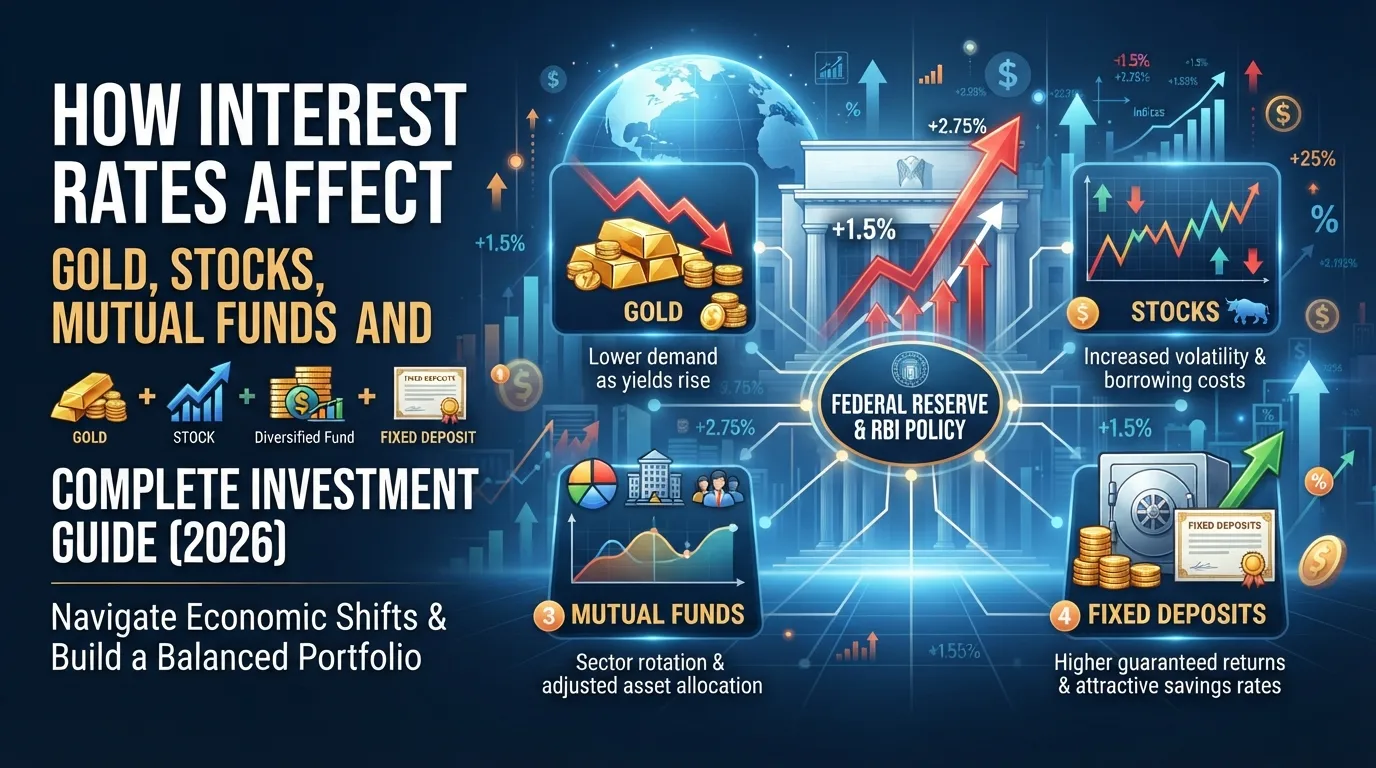
Interest rates play a crucial role in determining the performance of gold, stocks, mutual funds and fixed deposits. Learn how changes in central bank interest rates impact different investment options and discover strategies to build a balanced portfolio in varying economic conditions.
We publish educational market explainers so readers can connect daily price movement with long-term investing concepts, common risks, and decision-making basics.
Published by Metal Stock Rates and reviewed under our editorial standards on Thursday, July 16, 2026.
- What Are Interest Rates?
- Why Do Central Banks Change Interest Rates?
- Why Investors Should Care About Interest Rates
- How Rising Interest Rates Affect Gold Prices
- Impact of Interest Rates on the Stock Market
- How Mutual Funds Respond to Interest Rate Changes
How Interest Rates Affect Gold, Stocks, Mutual Funds and Fixed Deposits: Complete Investment Guide (2026)
Interest rates are among the most influential economic factors affecting financial markets worldwide. Whether you invest in gold, stocks, mutual funds, fixed deposits, bonds or other financial instruments, changes in interest rates can significantly impact returns, investment decisions and overall portfolio performance.
Whenever central banks adjust interest rates, investors across the globe closely monitor the announcement because borrowing costs, consumer spending, business investment and market sentiment often change as a result. These shifts eventually influence asset prices across multiple investment categories.
In this comprehensive investment guide, you'll learn how interest rates affect various asset classes, why investors closely follow central bank decisions and how you can make smarter investment choices during both rising and falling interest rate cycles.
| Investment Asset | Typical Impact of Rising Interest Rates |
|---|---|
| Gold | Generally faces downward pressure. |
| Stocks | Growth stocks may become more volatile. |
| Mutual Funds | Debt funds are usually affected more than equity funds. |
| Fixed Deposits | New deposits may offer higher returns. |
| Bonds | Existing bond prices generally decline. |
What Are Interest Rates?
An interest rate represents the cost of borrowing money or the return earned on savings and investments. Commercial banks, businesses, governments and individuals all depend on interest rates when borrowing or lending money. Central banks such as the Reserve Bank of India (RBI) and the US Federal Reserve influence economic activity by adjusting benchmark interest rates.
When interest rates increase, borrowing becomes more expensive for businesses and consumers. Higher loan costs may reduce spending and investment, slowing economic growth. Conversely, lower interest rates make borrowing cheaper, encouraging consumption, business expansion and investment activity.
Because interest rates influence almost every sector of the economy, they play a significant role in determining the performance of financial markets.
| Interest Rate Movement | Economic Effect |
|---|---|
| Higher Interest Rates | Higher borrowing costs, slower spending and tighter liquidity. |
| Lower Interest Rates | Cheaper loans, increased spending and improved business activity. |
| Stable Interest Rates | Generally creates predictable investment conditions. |
Why Do Central Banks Change Interest Rates?
Central banks adjust interest rates to maintain economic stability. Their primary objectives typically include controlling inflation, supporting employment, maintaining financial stability and encouraging sustainable economic growth. During periods of high inflation, interest rates may be increased to reduce excessive spending. During economic slowdowns, rates are often lowered to stimulate borrowing and investment.
These policy decisions influence commercial bank lending rates, home loans, personal loans, corporate borrowing costs and investment returns across multiple asset classes.
| Reason | Why It Matters |
|---|---|
| Control Inflation | Reduces excessive demand and price increases. |
| Support Economic Growth | Encourages borrowing and business investment. |
| Maintain Financial Stability | Helps balance credit growth and liquidity. |
| Manage Currency Strength | Influences capital flows and exchange rates. |
Why Investors Should Care About Interest Rates
Interest rate decisions influence almost every investment category. Stock market valuations, gold prices, bond yields, mutual fund performance, fixed deposit returns and even real estate prices often respond to changes in monetary policy. Understanding these relationships allows investors to make better asset allocation decisions instead of reacting emotionally to short-term market movements.
Rather than focusing only on daily market fluctuations, successful investors evaluate how changing interest rate environments may affect their long-term financial goals and diversify their portfolios accordingly.
How Rising Interest Rates Affect Gold Prices
Gold has traditionally been viewed as a safe-haven investment during periods of economic uncertainty. However, its performance is closely linked to interest rate expectations. Since gold does not generate regular income like fixed deposits or bonds, rising interest rates often reduce its short-term attractiveness for some investors.
When central banks increase interest rates, savings accounts, government securities and fixed-income investments generally offer better returns. As a result, some investors may shift their money away from gold toward interest-bearing assets. This change in capital allocation can temporarily slow demand for bullion.
Despite this relationship, gold continues to serve as an important portfolio diversifier. During periods of financial instability, geopolitical tensions or elevated inflation, investors often continue purchasing gold regardless of higher interest rates because of its reputation as a long-term store of value.
| Rising Interest Rates | Possible Effect on Gold |
|---|---|
| Higher Bank Returns | Some investors shift away from gold. |
| Higher Bond Yields | Alternative investments become more attractive. |
| Economic Uncertainty | May continue supporting gold demand. |
| Inflation Concerns | Can offset negative pressure on gold prices. |
Impact of Interest Rates on the Stock Market
The stock market often reacts quickly to changes in interest rates because borrowing costs directly influence corporate profitability. Higher interest rates increase financing expenses for businesses, potentially reducing future earnings and slowing expansion plans. Companies that rely heavily on borrowed capital may experience greater pressure during periods of rising rates.
Growth-oriented companies, particularly those in technology and emerging industries, are generally more sensitive to interest rate changes because investors value them based on expected future earnings. Higher discount rates can reduce the present value of those future cash flows, leading to greater market volatility.
On the other hand, falling interest rates often encourage businesses to invest, consumers to spend and investors to allocate more capital toward equities, creating a favourable environment for long-term stock market growth.
| Interest Rate Direction | Likely Impact on Stocks |
|---|---|
| Rates Increase | Higher volatility and increased borrowing costs. |
| Rates Decrease | Supports corporate growth and investor confidence. |
| Stable Rates | Creates a predictable investment environment. |
How Mutual Funds Respond to Interest Rate Changes
The effect of interest rates on mutual funds depends largely on the type of fund. Equity mutual funds primarily follow stock market performance, while debt mutual funds are directly influenced by changes in bond yields and interest rates.
When interest rates rise, existing bonds with lower coupon rates often become less attractive, causing bond prices to decline. This may temporarily affect the value of debt-oriented mutual funds. Conversely, falling interest rates generally support bond prices and improve returns for many fixed-income funds.
Investors should therefore consider the duration, risk profile and investment objective of a mutual fund before making decisions based solely on interest rate expectations.
| Mutual Fund Type | Interest Rate Sensitivity |
|---|---|
| Equity Funds | Indirectly affected through stock market performance. |
| Debt Funds | Directly influenced by bond yields. |
| Hybrid Funds | Moderately affected due to mixed asset allocation. |
| Liquid Funds | Usually experience relatively lower volatility. |
Interest Rates and Fixed Deposits
Unlike many market-linked investments, fixed deposits generally become more attractive when interest rates increase. Banks often revise deposit rates upward after central bank policy changes, allowing new investors to earn better returns on fresh deposits.
However, existing fixed deposits continue earning the interest rate agreed upon at the time of investment. This means investors who locked their money into lower-rate deposits may not immediately benefit from future rate increases until those deposits mature.
| Investment | When Rates Rise | When Rates Fall |
|---|---|---|
| Gold | May face short-term pressure. | Often benefits. |
| Stocks | Growth may slow temporarily. | Generally positive for equities. |
| Debt Mutual Funds | Can experience price declines. | Often benefit from rising bond prices. |
| Fixed Deposits | New deposits may offer higher returns. | New deposit rates usually decline. |
How Interest Rates Affect Bonds
Bonds are among the asset classes most directly affected by interest rate movements. When interest rates rise, newly issued bonds generally offer higher yields, making older bonds with lower coupon rates less attractive. As a result, the market value of existing bonds tends to decline.
Conversely, when interest rates fall, existing bonds offering higher coupon rates become more valuable because new bonds are issued with comparatively lower yields. This inverse relationship between bond prices and interest rates is one of the fundamental concepts of fixed-income investing.
Investors holding long-duration bonds should be especially aware of interest rate risk, as longer-term securities generally experience larger price fluctuations than short-term bonds.
| Interest Rate Scenario | Impact on Bond Prices |
|---|---|
| Interest Rates Rise | Existing bond prices generally decline. |
| Interest Rates Fall | Existing bond prices generally increase. |
| Stable Interest Rates | Bond prices usually remain relatively steady. |
Real Estate and Interest Rates
The real estate market is also closely linked to interest rate movements. Higher interest rates typically increase home loan and commercial borrowing costs, making property purchases more expensive for both individuals and businesses. This may slow demand in the real estate sector over time.
On the other hand, lower interest rates generally make home loans more affordable, encouraging residential property purchases and supporting construction activity. Real estate developers also benefit from lower financing costs, which can stimulate new projects and investment.
While interest rates play a major role, property prices are also influenced by location, infrastructure development, employment opportunities and overall economic growth.
Building an Investment Portfolio During Different Interest Rate Cycles
Instead of concentrating investments in a single asset class, many experienced investors prefer building diversified portfolios that can perform across different economic environments. Diversification helps reduce overall portfolio risk because different assets often respond differently to changes in interest rates.
For example, while rising interest rates may temporarily pressure growth stocks and gold, they could improve returns on newly issued fixed deposits and certain fixed-income investments. Likewise, falling interest rates may support equities and precious metals while reducing future deposit rates.
Maintaining a balanced asset allocation allows investors to navigate changing market conditions without making emotional investment decisions.
| Economic Environment | Investment Areas That May Benefit |
|---|---|
| Rising Interest Rates | Fixed Deposits, short-duration debt instruments and selective banking stocks. |
| Falling Interest Rates | Equities, gold, long-duration bonds and real estate. |
| Stable Interest Rates | Balanced portfolios with diversified asset allocation. |
Practical Tips for Investors
Understanding interest rate cycles can help investors make more informed financial decisions. Rather than attempting to predict every central bank announcement, it is often more effective to focus on long-term financial goals, diversification and disciplined investing.
| Investment Tip | Benefit |
|---|---|
| Diversify Across Asset Classes | Reduces concentration risk. |
| Review Portfolio Periodically | Keeps investments aligned with goals. |
| Monitor Central Bank Policies | Helps understand market direction. |
| Invest for the Long Term | Reduces the impact of short-term volatility. |
| Maintain an Emergency Fund | Avoids forced liquidation of investments. |
Common Mistakes Investors Should Avoid
Many investors make emotional decisions whenever interest rates change. Some sell quality investments during short-term market declines, while others chase recent winners without considering long-term fundamentals. Such behaviour can negatively affect investment performance over time.
Instead of reacting to every interest rate announcement, investors should evaluate how changing monetary policy affects their financial objectives, investment horizon and overall risk tolerance before making portfolio adjustments.
| Common Mistake | Better Approach |
|---|---|
| Panic Selling | Stay focused on long-term objectives. |
| Ignoring Diversification | Spread investments across multiple assets. |
| Timing Every Market Move | Follow a disciplined investment plan. |
| Chasing High Returns | Evaluate both risk and return. |
| Ignoring Inflation | Consider real purchasing power over time. |
Frequently Asked Questions (FAQs)
Why do interest rates affect investment returns?
Interest rates influence borrowing costs, business profits, consumer spending and investment decisions. Changes in interest rates can therefore impact the performance of stocks, gold, mutual funds, bonds, fixed deposits and real estate in different ways.
Is gold a good investment when interest rates rise?
Gold may experience short-term pressure when interest rates increase because interest-bearing investments become more attractive. However, gold often continues to serve as a long-term hedge against inflation, currency weakness and economic uncertainty.
Which investments usually benefit from higher interest rates?
Higher interest rates often improve returns on newly issued fixed deposits, savings products and certain short-term fixed-income investments. Banking institutions may also benefit from improving lending margins, although overall market conditions remain important.
How do interest rates impact mutual funds?
Debt mutual funds are generally more sensitive to interest rate movements because bond prices change as yields move. Equity mutual funds are influenced indirectly through stock market performance, corporate earnings and investor sentiment.
Should investors change their portfolio after every interest rate announcement?
Not necessarily. Interest rate decisions are only one of many factors affecting investment performance. Investors should focus on long-term financial goals, maintain proper diversification and review their portfolios periodically instead of reacting to every policy announcement.
Final Thoughts
Interest rates are one of the most powerful forces shaping financial markets. Whether you invest in gold, stocks, mutual funds, bonds, fixed deposits or real estate, changes in monetary policy can influence returns, investor sentiment and market volatility. Understanding these relationships helps investors make informed decisions rather than reacting emotionally to short-term market movements.
No single investment performs best in every economic environment. During periods of rising interest rates, certain fixed-income investments and banking-related assets may become more attractive, while falling rates often support equities, gold and long-duration bonds. A well-diversified portfolio helps reduce risk by balancing exposure across multiple asset classes.
Successful investing is not about predicting every interest rate decision. Instead, it involves understanding how different investments respond to changing economic conditions, staying disciplined during market fluctuations and maintaining a long-term perspective. Reviewing your financial goals regularly and adjusting your asset allocation when necessary can contribute to more consistent investment outcomes.
This guide is intended for educational and informational purposes only. Before making any investment decisions, consider your financial objectives, investment horizon and risk tolerance, or consult a qualified financial advisor for personalised guidance.
Topics Covered
Prepares educational explainers, updates evergreen market guides, and reviews site content for clarity, consistency, and reader usefulness.
For corrections, feedback, or source-quality concerns, visit our contact page or review our editorial policy.