Stock Market Holiday June 2026: Muharram Closure Impact on BSE & NSE and Market Outlook
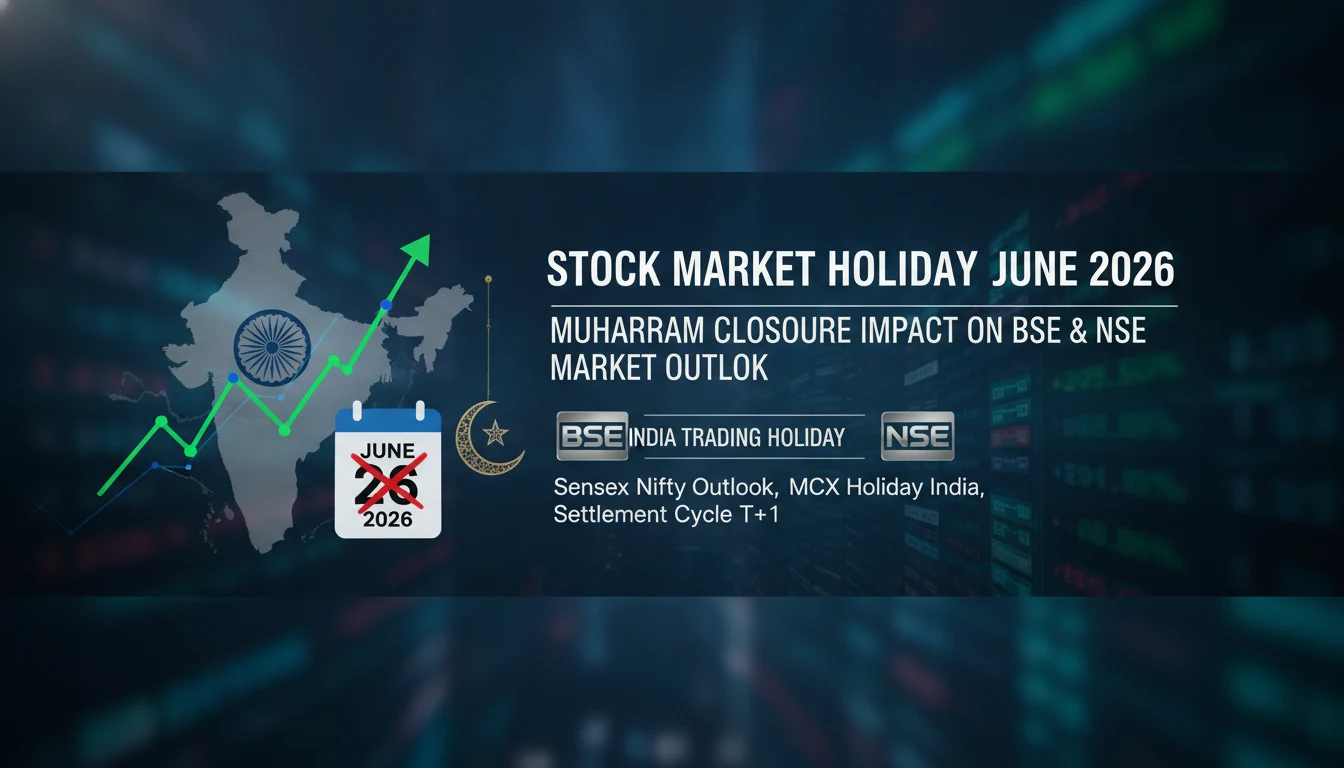
Indian stock markets remain closed on June 26, 2026 for Muharram, affecting trading activity, settlements, and short-term market strategy.
We publish educational market explainers so readers can connect daily price movement with long-term investing concepts, common risks, and decision-making basics.
Published by Market Insights Desk and reviewed under our editorial standards on Friday, June 26, 2026.
- Why the Market is Closed on Muharram
- Segments Affected by the Holiday
- Impact on Settlement Cycle (T+1)
- Sensex and Nifty Market Outlook
- Key Factors Influencing Market Next Week
- Sector Performance Snapshot
Stock Market Holiday on June 26, 2026: What Traders Should Know
Indian equity markets, including the Bombay Stock Exchange (BSE) and the National Stock Exchange (NSE), remain closed on June 26, 2026, in observance of Muharram. This closure affects all major segments such as equity cash, derivatives, currency derivatives, and securities lending. For traders and investors, this holiday creates a short pause in market activity, influencing settlement cycles and short-term trading strategies.
With global markets still active during this period, domestic participants often use such breaks to reassess positions, review risk exposure, and prepare for upcoming economic data releases. The closure also leads to a long weekend effect in trading activity, with markets reopening on June 29, 2026.
Why the Market is Closed on Muharram
Muharram is one of the most significant months in the Islamic calendar, and Ashura, the 10th day of Muharram, is observed as a day of remembrance. In India, stock exchanges recognize this as a trading holiday, aligning with national holiday calendars and financial sector regulations.
During this day, no trading activity takes place across equity, futures & options (F&O), and currency markets. Even settlement operations are affected due to the clearing holiday status.
Segments Affected by the Holiday
The market closure is comprehensive and impacts multiple financial instruments. Below is a breakdown of affected segments:
| Market Segment | Status on June 26, 2026 | Impact |
|---|---|---|
| Equity Cash Market | Closed | No buying or selling of shares |
| Futures & Options (F&O) | Closed | No derivatives trading |
| Currency Derivatives | Closed | Forex trading halted |
| MCX Commodities | Partial Holiday | Day session closed, evening session may vary |
| Securities Lending & Borrowing | Closed | No transactions allowed |
Impact on Settlement Cycle (T+1)
India follows a T+1 settlement cycle, meaning trades are settled one business day after execution. A market holiday directly impacts this cycle.
For example, trades executed on June 25, 2026 will not settle on June 26 due to the holiday. Instead, settlement will be pushed to the next working day, June 29, 2026.
| Trade Date | Normal Settlement | Revised Settlement |
|---|---|---|
| June 25, 2026 | June 26, 2026 | June 29, 2026 |
| June 26, 2026 | N/A (Holiday) | June 29, 2026 |
Sensex and Nifty Market Outlook
In the week leading up to the holiday, Indian benchmark indices such as Sensex and Nifty showed mixed but resilient movement. While global cues remained uncertain, domestic liquidity and sector rotation supported the market.
Experts suggest that short-term consolidation is likely, especially as investors await key macroeconomic data from the US and India. Inflation trends, crude oil prices, and foreign institutional investor (FII) activity will remain key drivers.
Key Factors Influencing Market Next Week
- US inflation and employment data influencing global risk sentiment
- Crude oil price stability supporting Indian macros
- Monsoon progress impacting rural demand
- Upcoming Q1 corporate earnings expectations
- FII/DII investment flows in equity markets
Sector Performance Snapshot
Before the holiday, market sectors showed mixed performance with selective buying interest in defensive sectors.
| Sector | Performance Trend | Reason |
|---|---|---|
| Pharma & Healthcare | Positive | Defensive buying and stable demand |
| Banking | Stable | Improved credit outlook |
| Metals | Weak | Decline in global commodity prices |
| Auto & Consumer | Mixed | Demand uncertainty and rural sentiment |
What Traders Should Do During the Holiday
A trading holiday is not just a break but also an opportunity for strategy refinement. Investors often use such pauses to rebalance portfolios, analyze global trends, and prepare for volatility ahead.
- Review open positions and risk exposure
- Track global markets for overnight cues
- Rebalance portfolio allocation across sectors
- Focus on fundamentally strong stocks
- Avoid emotional trading after the holiday gap
Conclusion
The Muharram holiday on June 26, 2026, brings a temporary halt in Indian stock market activity, impacting trading, settlement, and short-term strategies. While such closures may appear disruptive, they are well-integrated into the financial system and rarely affect long-term market direction.
For investors, the key takeaway is to remain informed and cautious, especially around global events and macroeconomic releases. With markets expected to reopen on June 29, 2026, traders should be prepared for possible volatility as global cues accumulate over the holiday period.
Topics Covered
Prepares educational explainers, updates evergreen market guides, and reviews site content for clarity, consistency, and reader usefulness.
For corrections, feedback, or source-quality concerns, visit our contact page or review our editorial policy.