US Stock Market Update: Nasdaq 100 Extends 3-Day Fall – Tech Stocks Under Pressure Amid AI Valuation Concerns
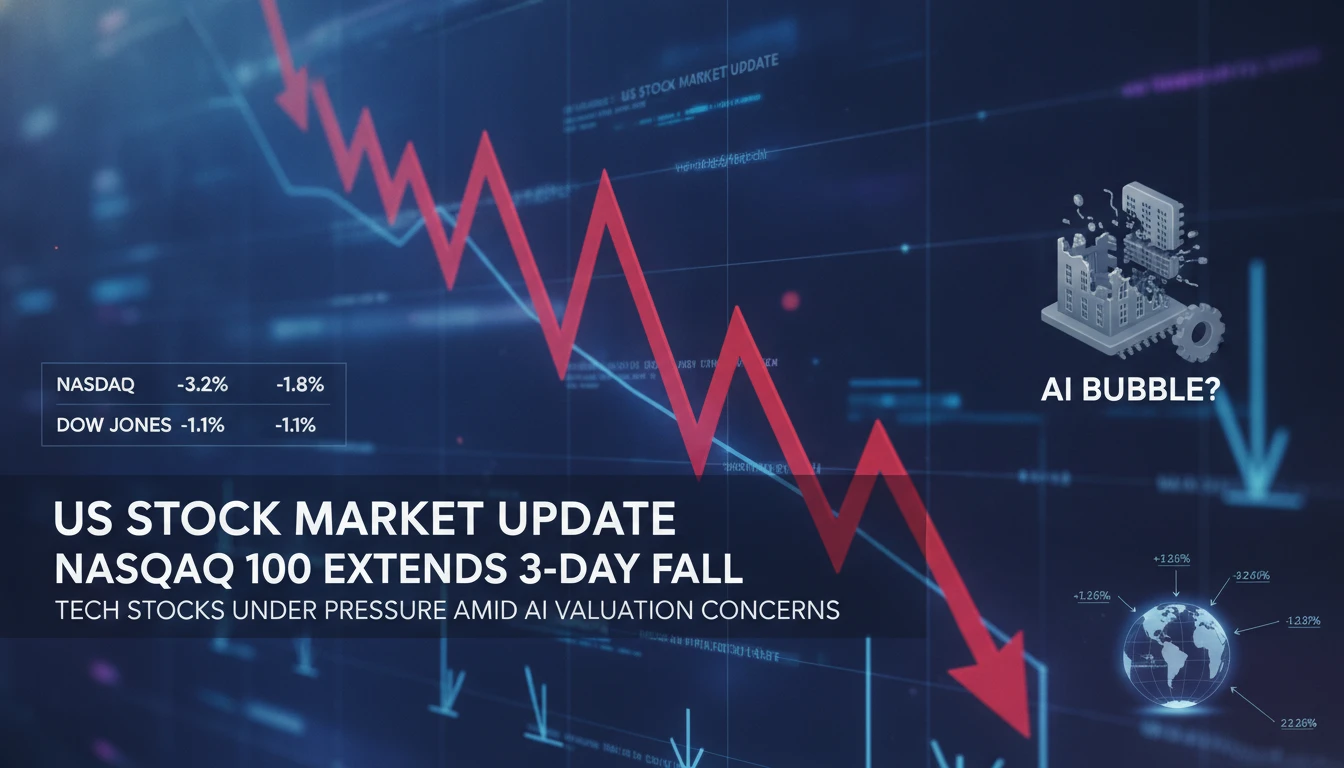
Nasdaq 100 continues its downward trend as tech stocks face selling pressure. Explore reasons behind the decline, AI valuation concerns, and global market impact.
We publish educational market explainers so readers can connect daily price movement with long-term investing concepts, common risks, and decision-making basics.
Published by Metal Stock Rates and reviewed under our editorial standards on Thursday, June 25, 2026.
- Nasdaq 100 Performance Over the Last 3 Days
- Why Is Nasdaq Falling?
- Impact on Semiconductor Stocks
- Is the AI Bubble Burst Coming?
- Dow Jones and S&P 500 Performance
- Global Market Impact
US Stock Market Update: Nasdaq 100 Extends 3-Day Fall Amid Tech Selloff and AI Valuation Concerns
The US stock market witnessed heightened volatility as the Nasdaq 100 index extended its losing streak for the third consecutive trading session. Heavy selling pressure in technology and semiconductor stocks dragged the index lower, raising concerns among investors about stretched valuations in AI-related companies.
While broader indices like the Dow Jones Industrial Average and S&P 500 showed relative stability, the tech-heavy Nasdaq remained under pressure as investors rotated out of high-growth technology stocks amid uncertainty over future earnings sustainability.
Nasdaq 100 Performance Over the Last 3 Days
The Nasdaq 100 has seen a sharp correction over the past three sessions, with a cumulative decline of nearly 1,200 points. The index faced intraday volatility as investors booked profits in major semiconductor and AI-linked companies.
| Date | Closing Level | Change |
|---|---|---|
| June 22 | 26,517 | -1.32% |
| June 23 | 25,586 | -2.21% |
| June 24 | 25,476 | -0.43% |
Why Is Nasdaq Falling?
The primary reason behind the recent decline in Nasdaq is profit booking in high-growth technology stocks, especially in the semiconductor and artificial intelligence sectors. These sectors had previously seen strong rallies, leading to elevated valuations.
Investors are now reassessing whether the rapid rise in AI-related stocks is justified by actual earnings growth or driven mainly by speculative enthusiasm.
- Profit booking in AI and tech stocks
- Concerns over high valuations
- Rising interest rate expectations
- Portfolio rebalancing by institutional investors
- Global risk-off sentiment
Impact on Semiconductor Stocks
Semiconductor companies were among the hardest hit during the selloff. These stocks had previously led the market rally, driven by strong demand for chips used in AI systems, cloud computing, and advanced data centers.
However, volatility increased as investors locked in gains. Despite short-term weakness, analysts believe the semiconductor sector continues to show strong long-term growth potential.
| Sector | Performance Trend |
|---|---|
| Semiconductors | Strong volatility, short-term decline |
| AI Technology Stocks | Profit booking pressure |
| Dow Jones | Stable to positive |
| S&P 500 | Mixed performance |
Is the AI Bubble Burst Coming?
One of the major discussions in the market revolves around whether artificial intelligence stocks are forming a speculative bubble. After a strong rally over the past year, AI-related companies have become heavily concentrated in major indices.
While valuations appear stretched in some cases, most analysts believe this is a healthy correction rather than the end of the AI growth cycle. Earnings growth remains strong in several leading technology companies.
Market Insight: Experts suggest the current decline is driven more by valuation adjustments and positioning rather than a fundamental breakdown in AI demand.
Dow Jones and S&P 500 Performance
Unlike the Nasdaq, the Dow Jones Industrial Average showed relative strength and ended the session in positive territory. The S&P 500 also remained stable, reflecting a more balanced market performance outside of the technology sector.
This divergence highlights the concentration risk in US equity markets, where a small group of tech stocks heavily influences overall index performance.
Global Market Impact
The US tech selloff also influenced global markets, with Asian and European indices reacting to the weakness in semiconductor and AI-related stocks. However, some recovery was seen in futures trading following strong earnings reports from key chip manufacturers.
Markets remain highly sensitive to earnings announcements, inflation data, and central bank commentary.
Investor Strategy in Volatile Markets
| Investor Type | Recommended Approach |
|---|---|
| Short-Term Traders | Focus on volatility-based opportunities |
| Long-Term Investors | Hold quality tech stocks with strong earnings |
| Risk-Averse Investors | Diversify into defensive sectors |
Future Outlook for US Markets
Despite short-term corrections, the long-term outlook for US equities remains constructive. Technology, artificial intelligence, and semiconductor sectors are expected to continue driving earnings growth over the coming years.
However, market leadership is expected to broaden beyond a small group of mega-cap tech stocks, leading to more balanced index performance.
Conclusion
The recent Nasdaq 100 decline highlights the importance of valuation discipline and diversification in equity markets. While short-term volatility may continue, long-term structural growth in AI and technology remains intact. Investors should focus on quality, earnings visibility, and risk management in an evolving global market environment.
Topics Covered
Prepares educational explainers, updates evergreen market guides, and reviews site content for clarity, consistency, and reader usefulness.
For corrections, feedback, or source-quality concerns, visit our contact page or review our editorial policy.